00:00:00.000 — The still features a color test pattern with segments ranging from black to white, indicating various shades of gray. The left side is black, transitioning through lighter shades to the far right, which is white. The overlay text reads 'Not For Broadcast,' suggesting it's a technical or preview segment rather than the main content. A time code appears at the bottom.
00:00:03.103 — The still shows a black screen with the text 'Not For Broadcast' prominently displayed. There’s also a timecode in the lower left corner indicating the footage length. This suggests it's a preliminary or instructional frame from the 'Sixth Grade Linguistics' educational film.
00:00:15.115 — The still shows a black screen with the text 'Not For Broadcast' prominently displayed. In the bottom left corner, there is a timecode indicating the duration of the footage at 15 seconds and 103 milliseconds. This appears to be an introduction or a placeholder from the educational film focused on linguistics for sixth graders.
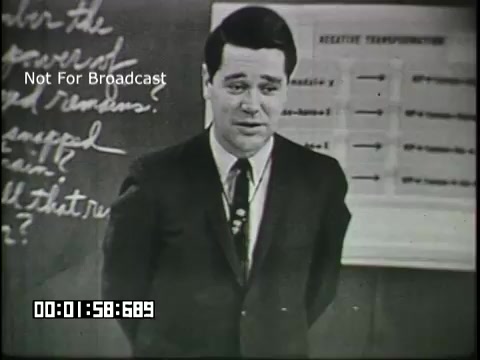
00:01:58.785 — The still features a male educator in a suit, standing in front of a chalkboard with written notes and a poster displaying a chart labeled 'Relative Pronouns.' He appears to be engaging with an audience, possibly students, as part of an educational segment focused on linguistics for sixth graders. The overall tone seems instructional and informative.
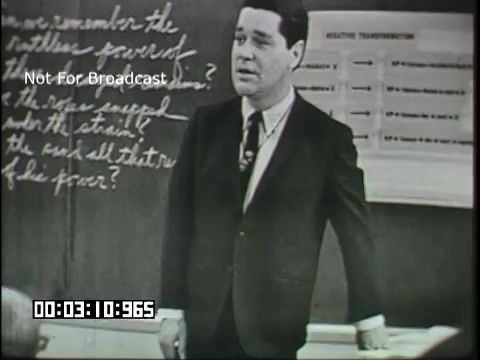
00:03:11.124 — The still features a male instructor in a suit standing in front of a classroom blackboard. He is engaged in a lecture, addressing students off-camera. The blackboard contains notes and questions related to linguistics, reinforcing the educational theme of the film. The visual style suggests a mid-20th-century educational context, with an emphasis on traditional teaching methods.
00:03:42.322 — The still features a young student in a classroom setting, engaged in discussion. He has a thoughtful expression and is sitting at a desk with his arm resting on it. The classroom appears traditional, with wooden desks and a chalkboard in the background. The film is marked 'Not For Broadcast' and displays a timestamp at the bottom. It captures a moment intended to illustrate a teaching scenario related to linguistics for a sixth-grade audience.
00:05:49.449 — The still from the 'Sixth Grade Linguistics' educational film depicts a young girl intently reading a book. The visual quality suggests an older film format, likely a 16mm projection. There are overlay elements, including a timestamp and the label 'Not For Broadcast,' indicating it's a restricted educational content. The scene likely emphasizes engagement with language and literacy as part of the curriculum.
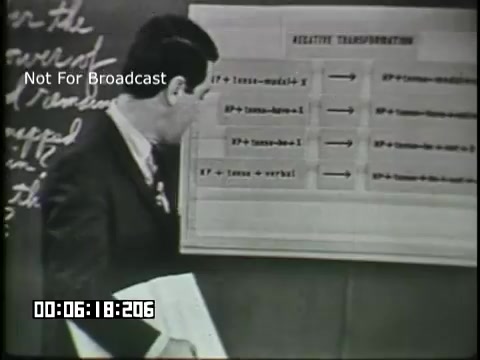
00:06:18.545 — The still features a male instructor in a classroom setting, presenting material related to linguistics. He is standing next to a chart titled 'Relative Transformation,' which likely outlines grammatical concepts or transformations. The background shows a chalkboard with text, indicating an educational environment. The frame includes a timestamp, suggesting it’s part of a film intended for instructional purposes.
00:06:49.209 — The still from the 'Sixth Grade Linguistics' educational film features a young boy named Scott sitting at a classroom desk. He appears attentive, with his hands crossed in front of him. A book is open on his desk, and there are blurred classmates in the foreground. The classroom has wooden elements and blinds in the background, suggesting a typical mid-20th century educational setting. The image conveys a focused learning environment.
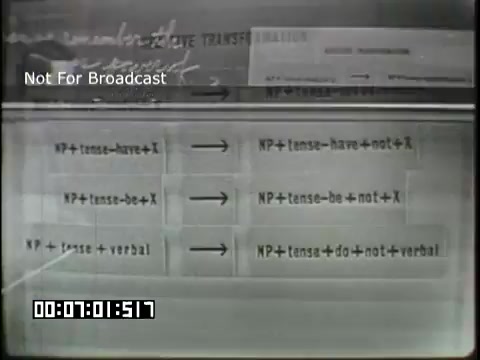
00:07:01.921 — The still from the 'Sixth Grade Linguistics' educational film presents a diagram outlining linguistic structures. It features equations showing transformations of noun phrases (NP) with various verb forms indicating tense, such as 'have,' 'be,' and 'do,' leading to grammatical constructs. The text is simplified for educational purposes, aimed at teaching sixth graders about sentence structure.
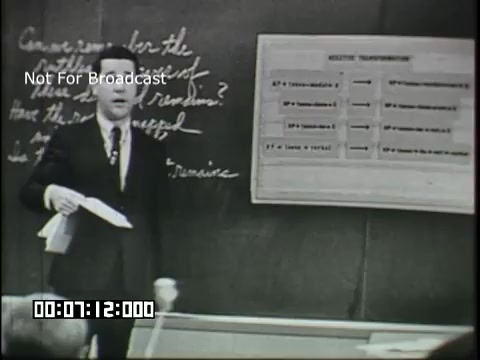
00:07:12.399 — The still features a man standing in front of a classroom setting, holding notes and addressing students. Behind him is a blackboard with handwritten content and a poster displaying linguistic transformations, indicating a focus on teaching language concepts. The atmosphere reflects an educational environment aimed at teaching sixth graders about linguistics.
00:07:17.704 — The still from 'Sixth Grade Linguistics' features a classroom setting where students are engaged in learning. A blurred focus on a student writing in a notebook emphasizes the educational theme, while other students are visible in the background, likely participating in the lesson. The frame includes a 'Not For Broadcast' label, indicating it's intended for restricted viewing. Overall, it captures a moment of academic focus in a sixth-grade environment.
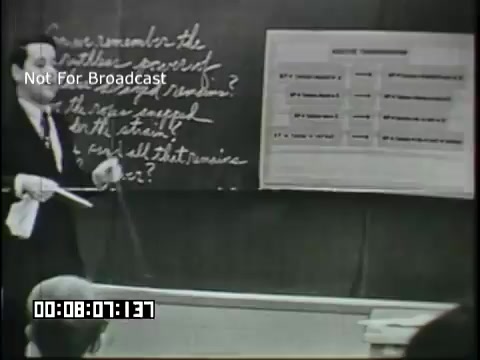
00:08:07.620 — The still depicts an educational setting from the 'Sixth Grade Linguistics' film, featuring an instructor standing beside a chalkboard filled with handwritten text. The teacher is gesturing towards a visual aid, likely a chart or table, while students are seated in the foreground, engaged in the lesson. The atmosphere is focused on learning linguistic concepts.
00:08:54.300 — The still from 'Sixth Grade Linguistics' depicts a classroom scene where a student, wearing a button-up shirt, is reading from a book. The focus is on the student, who appears engaged and expressive, while a few classmates are seen in the background, some of whom are attentive to the reading. The environment suggests a typical educational setting, reinforced by classroom elements like windows and bookshelves. The film uses a vintage aesthetic characteristic of educational media from that era.
00:09:20.760 — The still features a smiling young girl with short hair, sitting at a desk and engaging with a large book. She appears to be participating in an educational setting, likely discussing or learning about linguistics. The classroom background suggests a focus on interactive learning, with resources visible behind her. The scene captures a moment of engagement and curiosity in a sixth-grade context.
00:09:23.329 — The still from the 'Sixth Grade Linguistics' educational film features a man dressed in a suit, standing in front of a blackboard with handwritten notes. He appears to be mid-sentence, possibly engaging with an audience or students. The setting suggests a classroom environment, highlighting a topic related to linguistics. The timestamp indicates that it is part of a longer presentation. The image is marked 'Not For Broadcast,' implying it may be for educational use only.
00:09:30.703 — The still from the 'Sixth Grade Linguistics' educational film features a classroom scene where a student, seated at a desk, has raised their hand, presumably to answer a question or participate in a discussion. The student is focused, and a book is open on the desk, indicating an active learning environment. Other students in the background appear engaged as well. The image captures a moment of interaction typically found in a sixth-grade classroom setting.
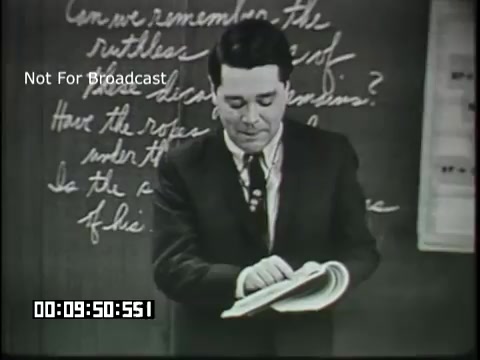
00:09:51.091 — The still features a male educator standing in front of a blackboard filled with handwritten notes. He appears to be engaged in teaching, holding an open book in one hand while referencing the content. The educator is dressed in a suit and tie, suggesting a formal classroom setting. The blackboard contains phrases likely related to linguistic concepts, indicating the educational theme of the film directed towards sixth-grade students. A timestamp at the bottom suggests it is a clip from a longer presentation.
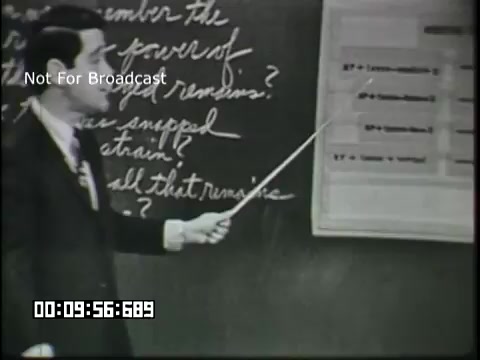
00:09:57.263 — The still from 'Sixth Grade Linguistics' shows a male teacher standing in front of a blackboard, holding a pointer. He appears to be discussing linguistic concepts, indicated by the text and diagrams on the board. There are questions written in cursive and possibly a chart or table displayed next to him. The overall scene captures a classic educational setting typical of the mid-20th century.
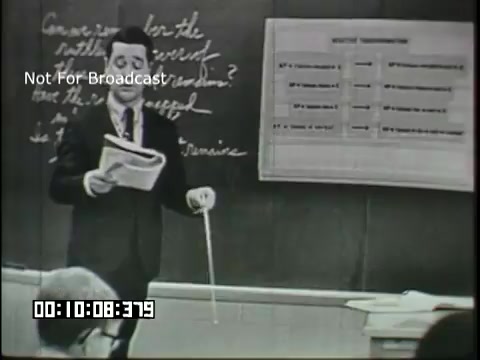
00:10:08.942 — The still features a male teacher standing in front of a classroom blackboard, holding papers in one hand and a pointer in the other. The blackboard displays handwritten notes, possibly related to a linguistics lesson, and a chart on the right side. The teacher appears to be engaging with students, emphasizing a point in the lesson. The context suggests an educational setting focused on linguistic concepts aimed at sixth graders.
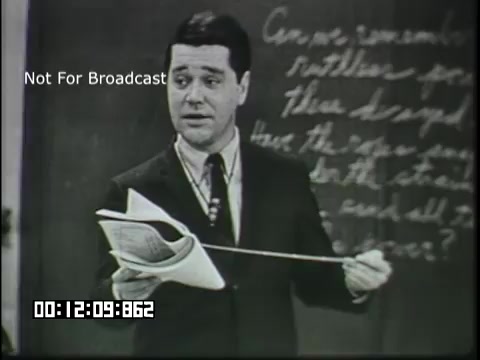
00:12:10.563 — The still features a male teacher standing in front of a blackboard filled with writing. He is dressed in a formal outfit with a tie, holding a sheet of paper and possibly pointing to key concepts as he addresses students. The overall setting suggests a classroom environment, aimed at educating sixth graders about linguistics. The tone appears serious yet engaging, typical of educational films from that era.
00:12:56.809 — The still features a classroom setting from the 'Sixth Grade Linguistics' educational film. A student is sitting at a desk with an open book, appearing engaged in learning. Other students are visible in the background, also seated at their desks. The monochrome film captures the atmosphere of a 1960s educational environment. 'Not For Broadcast' is overlaid on the image, with a timestamp indicating the specific moment in the film.
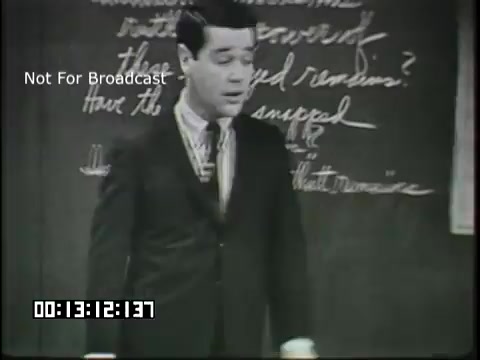
00:13:12.925 — The still shows a young man in a suit standing in front of a chalkboard covered with handwritten notes. He appears to be engaged in teaching, possibly discussing linguistic concepts relevant to sixth graders. The scene captures an educational moment, emphasizing the interaction between teacher and students. The time code at the bottom indicates the film's progression.
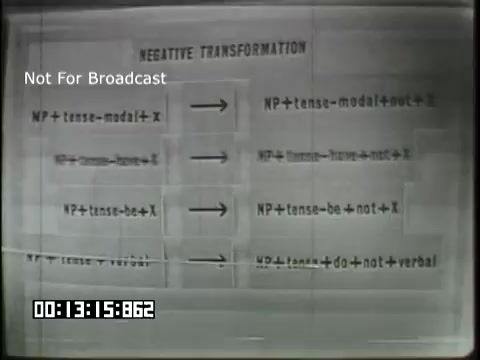
00:13:16.629 — The still from the 'Sixth Grade Linguistics' educational film presents a chart titled 'Negative Transformation.' It outlines various grammatical structures denoting negative forms. The transformations show how to negate sentences involving different verb forms (modal, tense, be, and do). The visual format is clear and instructional, aimed at teaching sixth graders about sentence structure and negation in linguistics.
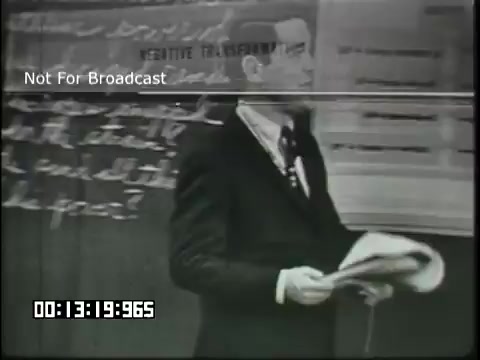
00:13:20.733 — The still features a man, likely a teacher, standing in front of a blackboard. He is dressed in a suit and appears to be holding papers, possibly related to the lesson. The background displays handwritten notes or diagrams relevant to linguistics, reflecting an educational context aimed at sixth graders. The image conveys a formal classroom setting typical of a mid-20th-century educational film.
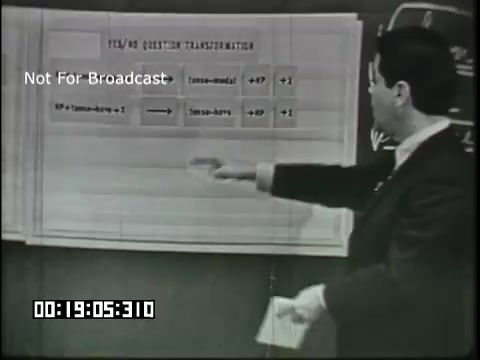
00:19:06.412 — The still from the 'Sixth Grade Linguistics' educational film shows a male instructor standing next to a large chart. He is gesturing towards the chart, which appears to display question transformation rules. The background is a classroom setting, emphasizing a teaching moment focused on linguistics. The timestamp and 'Not For Broadcast' label indicate it is a recorded educational segment.
00:19:16.656 — The still features a classroom setting from a 16mm educational film titled 'Sixth Grade Linguistics.' A student is depicted seated at a desk with papers in front, seemingly engaged in a lesson. The image has a slight overlay or blur, possibly indicating it captures a significant moment in the film, such as a discussion or explanation related to linguistics. The timecode and 'Not For Broadcast' label are also visible, indicating this is an archival or educational clip.
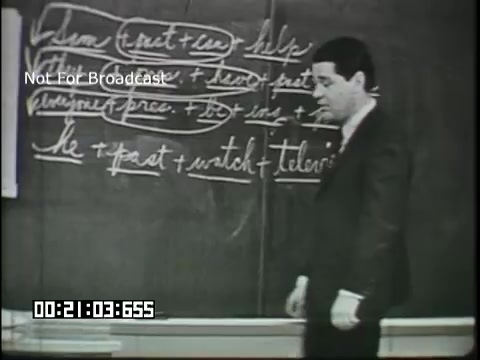
00:21:04.864 — The still features a male teacher standing in front of a chalkboard filled with linguistic notes and examples. He is engaged with the class, explaining concepts related to grammar, such as verbs and their forms. The setting has a vintage educational atmosphere typical of mid-20th century teaching films. The chalkboard displays phrases like 'I + past + watch + television,' emphasizing the structure of sentences. A timecode displays the footage's timestamp.
00:23:42.288 — The still shows a young student in a classroom raising their hand, likely to answer a question or participate in a discussion. The student has short, styled hair and is wearing a button-up shirt. The background features classroom elements, suggesting a learning environment. The image comes from a 16mm educational film titled 'Sixth Grade Linguistics.' The text 'Not For Broadcast' indicates it is not intended for public airing.
00:24:04.209 — The still features a classroom setting from the 'Sixth Grade Linguistics' educational film. A boy named Josh is seated at his desk, focused on the lesson. He is wearing a light-colored shirt and glasses. In the background, various classroom elements can be seen, including charts or posters related to the linguistic theme of the film. The ambiance suggests a typical learning environment aimed at middle school students.
00:24:26.065 — The still from the 'Sixth Grade Linguistics' educational film depicts a classroom setting with a focus on a teacher and students engaged in a lesson. It features a white board or a large paper surface that likely displays linguistic concepts or writing exercises. The overall atmosphere is educational, with an emphasis on interaction and learning. The timestamp indicates it's part of a segment, emphasizing a structured format typical of educational films from that era.
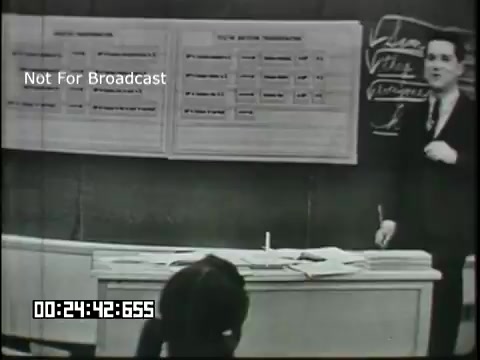
00:24:44.083 — The still depicts a classroom scene from the 'Sixth Grade Linguistics' educational film. In the foreground, a teacher stands at a chalkboard, addressing students. Behind him are two large posters displaying linguistic concepts. The classroom setting is simple, emphasizing the educational focus. The overall tone is instructional, aimed at teaching sixth graders about language and linguistics.
00:24:46.819 — The still from the 'Sixth Grade Linguistics' educational film features a classroom setting. A young boy with glasses and short hair appears to be attentive, sitting at a desk with his hands on the table. The atmosphere suggests a focus on learning, with other students visible in the background, creating an engaging educational environment. The image captures a moment in a learning context related to linguistics.
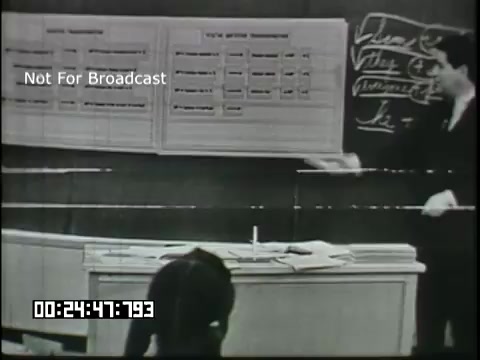
00:24:49.254 — The still from the 'Sixth Grade Linguistics' educational film features a classroom setting. A teacher, standing near a chalkboard, is gesturing towards a large display with organized text columns. The focus appears to be on teaching linguistic concepts, with materials and notes scattered on a desk in the foreground. The overall atmosphere is educational and structured, aimed at a sixth-grade audience.
00:25:24.123 — The still from the 'Sixth Grade Linguistics' educational film features two individuals in a classroom setting. One person, likely a student, is sitting at a desk, while the other appears to be a teacher standing beside a chalkboard filled with written content. Nearby, a large stack of papers is visible on the table. The atmosphere suggests a typical classroom interaction, focusing on linguistic concepts, aimed at a sixth-grade audience.
00:25:28.527 — The still features a classroom setting with a teacher seated at a desk in front of a blackboard. The atmosphere appears educational, focusing on sixth-grade linguistics. The desks are arranged in front of the teacher, indicating a traditional classroom layout. The image has a vintage feel, typical of mid-20th century educational films.
00:28:20.899 — The still from the 'Sixth Grade Linguistics' educational film is predominantly a black screen with the text 'Not For Broadcast' and a timecode displayed at the bottom. This suggests it may be a preview or an internal copy not intended for public viewing.
00:28:26.805 — The still features a stylized, white curved shape against a black background, possibly illustrating a concept in linguistics or writing. The context suggests it's part of an educational film aimed at sixth-grade students, focused on language or communication principles. The notation 'Not For Broadcast' indicates it is a restricted or archival image.
Film Transcript / Subtitles
A handful of red sand from the hot clime of Arab deserts brought within this glass becomes the spy of time, the minister of thought.
How many weary centuries has it been about those deserts blown? How many strange vicissitudes has seen? How many histories known? Perhaps the camels of Ishmaelite trampled and passed it o'er, went into Egypt from the patriarch's sight, his favorite son they bore.
Today's 6th grade linguistics lesson deals with the negative and the question transformations.
This lesson is taken from Book 6 of the Roberts English series.
The teacher is Mr. John J. Mahoney, consultant in English for the school department of Harcourt, Brace, and World.
And onward, and across the setting sun, across the boundless plain, calm in its border-shadow run, till thoughts besoose in vain.
The vision vanishes. These walls again shut out the lurid sun, shut out the hot and measurable plain.
The half-hour sand is run.
Kathy, that was excellent reading. Thank you very much. I think that by now, boys and girls, you are very familiar with the poem.
By the way, Kathy, what is the title of the poem you just read?
Sand of the Desert in an Hourglass.
Very good. And Kathy, who wrote the poem?
Henry Wadsworth Longfell.
Excellent. All right. Who remembers another poem that had something about sand in it?
You read it not too long ago. Janet?
Ozymandias.
Ozymandias. And Janet, who wrote Ozymandias? Do you remember?
Percy Weiss Shelley.
Shelley. All right. And should we ask you, Janet, do you know how to spell Shelley?
Capital S-H-E-L-L-E-Y.
Very good. And recently, Clash, you also were asked to write a composition. And in your composition, you had to talk about some items in both of these poems, Ozymandias and the sand poem.
What were the compositions about? What did you have to do in the compositions? Who can remember?
Oh, I see. Every hand up almost. Let's go way back to the rear mic. What did you have to do in the composition?
We were supposed to write about what we saw in that.
What you saw in what, Mike?
In the poem.
In the poem, yes. And more specifically, Janet, exactly what were you pretending to be?
We were pretending to be the sand, telling what we had seen of Ozymandias.
Right. And in what stages did you see Ozymandias or did you write about Ozymandias? Liz, in what stages in his development?
When he was, I think it was, when he was being built, when he was new and powerful. And now what you see, the ruins.
All right. And of course, the ruins are where?
In the sand.
In the sand. All right. As I read over your compositions, I selected three sentences, which I have here on the chalkboard.
Good. These are three sentences from three different compositions. Would you read the first one? Oh, Josh, can you read this first sentence up here, please?
Yes.
Can we remember the ruthless power of these decayed remains?
All right. And, Beth, would you try reading the second one?
Had the rope snapped under the stream.
All right. Very good. And, David, could you read the third?
As the sand all that remains of his power.
Is the sand all that remains of his power. Very good.
Who remembers what kind of sentences these are?
These sentences have a special name.
I see a lot of hands. How about it, Scott?
What kind of sentences are these?
Excuse me?
Questions.
Questions. Very good.
Today, we're going to talk about the yes-no question transformation.
By the way, who remembers what a transformation is?
A transformation, Josh, is a particular kind of sentence, isn't it?
Josh.
What kind is it?
A transform.
A transform. All right.
Well, a transform is a complex sentence.
All right. It's a type of more complicated sentence.
What is the other kind of sentence that we've already studied, Dave?
The kernel sentence.
So, we work with the kernel and we manipulate with the kernel somehow or other
and come up with a more complicated sentence called the transform.
All right.
And the process that we use is called the process of transformation.
Now, the negative transformation, which we've already studied,
is very, very similar to the yes-no question transformation,
which will be new for us today.
Would you open your books, please, to page 82?
It begins there, what sentences can we make negative
by simply adding the word not in the predicate?
How about that?
Janet, what sentences can we make negative this way?
The ones with tense modal and tense b and tense have.
Very good. All right.
The ones with tense modal, tense have, and tense b.
All right.
And, David, the next question,
where do we put the not in such sentences?
Well, you would put it right after the tense b, tense have, or tense modal.
All right.
Right after the tense modal will come the not,
or the tense have will come the not,
and the tense b will come the not.
All right.
Very good.
Scott, in what kind of sentence must we do something more
than just add the word not?
Do you remember?
Well, in some sentences, a tense verbal,
we had the word do before the not.
That's correct.
In some sentences, we don't have a modal, a have, or a be.
We have a tense with a verbal, a simple verbal.
And in that case, we have to add the do.
All right.
Kathy, would you please read this first line for us?
Just read it for us.
NP plus tense modal plus x
becomes NP plus tense modal plus not plus x.
All right.
And Beth, would you look carefully at the second line, please, and read it?
NP plus tense half plus x becomes NP plus tense half plus not plus x.
All right.
Let's have a couple of boys way up back there.
Dave, look at the third one, please.
See if you can keep up with these girls.
How about reading the third one for us?
NP plus tense b plus x becomes NP plus tense b plus not plus x.
All right.
And Mike, way back there.
How about looking at this fourth line and reading it?
NP plus tense plus verbal becomes NP plus tense plus do plus not plus verbal.
Excellent.
Very good.
Now, boys and girls, let's continue our review of the negative transformation.
Would you open the workbooks, please?
Open your workbooks, and we'll have an oral review from the workbooks.
Page 63.
The direction at the top of page 63 says,
Transform the following strings into negative strings by inserting not in the proper place.
And, as Mike referred to it before, remember to insert do if necessary.
Who would like to do the first one, please?
All right.
Well, we were back in the back.
Let's stay up in the back.
Liz, would you please read the first one?
It isn't raining.
It isn't raining.
Is that what you said, Liz?
Read exactly what you see in the book.
Beside number one.
It.
Plus present, plus may, plus rain.
Right.
It plus present, plus may, plus rain.
Now, that is called a morphine string.
Now, give me the sentence form of that string.
It wasn't.
It isn't raining.
It isn't raining.
Who can help her out a bit?
I see some hands.
I think somebody's going to disagree with you.
Way down here, Kathy.
What's, what's, how would you render that?
It may not rain.
It may not rain.
Is that an exact replica of the string as you see it in the book?
I'm only asking for the sentence of the string you see in the book.
It plus present, plus may, plus rain.
Beth, can you help us out?
It may rain.
It may rain.
It may rain.
Which one of these lines is this a sample of?
Dave, which line?
Nounth, phrase, plus tense modal, plus x.
All right.
It may rain.
And turned into a negative, Josh, what would that become?
What sentence would it become?
It would become, it may not rain.
It may not rain.
All right.
You get the idea?
Try number two.
May I ask Janet to please?
Please read number two.
Lucy, plus past, plus have, plus participle, plus take, plus it.
And translated into a sentence, Janet, that would be what?
Lucy had taken it.
Lucy had taken it.
And Janet, into a negative statement.
Lucy had not taken it.
Lucy had not taken it.
Which of these lines up here, is this an example of, Janet?
N, P, plus tense half, plus x.
All right.
Very good.
And let's see number three now, please.
Josh, how about trying number three?
The, plus school, plus present, plus B, plus honor, plus M, plus street.
All right.
Now, Dave, would you translate that, please, into a sentence?
The school is on Elm Street.
The school is on Elm Street.
All right.
And, Scott, would you turn that sentence of Dave's into a negative statement?
The school is not on Elm Street.
All right.
And, Scott, which one of these rules is applied here?
Noun phrase, plus tense B, plus x.
Excellent.
All right.
Let's do number five now.
Number five.
Liz, would you try number five?
Netta ran in the race.
All right.
First of all, Liz, please read the string as you see it in the book.
Netta, nedra, plus pass, plus run, plus in, plus the, plus race.
Very good.
Now, what is the sentence, Liz?
Had netta run in the race.
No, the sentence, the exact translation of the string you see in the book.
Oh.
Nedra, the past of run, is?
Ran.
Ran.
In the race.
In the race.
Sure.
Isn't that a good English sentence?
I just said that.
Oh, I'm sorry.
I didn't get away up here.
All right.
Nedra ran in the race.
Now turn that statement into a negative statement.
Netta hadn't run in the race.
All right.
What's another possible way of doing this?
Nedra hadn't ran in the race.
Well, that's possible.
But, David, how would you do it?
Nedra had not run in the race.
Nedra had not run.
Well, I see some hands up here.
Kathy, how would you do it?
Nedra did not run in the race.
Nedra did not run in the race.
Now, if we choose to do it in Kathy's fashion,
would one of these rules apply?
Kathy, tell them which one would apply.
N-P plus tense plus verbal.
Right.
And there's the verbal.
So when we have a verbal, as you recall,
we end up over here with simply a tense and not,
and we call that a floating tense, if you remember.
And whenever we have a floating tense,
we have to pull do in and use do.
All right.
Let's take a look at the yes-no question transformation here.
It's very, very much like the negative transformation.
Back in your textbook.
Please close your workbooks.
It's still on page 82 of the textbook.
The second paragraph.
May I have a volunteer reader?
Well, I think the first hand over there was your hand, Scott.
So I'm going to ask Scott to read for us.
The second paragraph, please.
The sentences that you have studied so far have all been statements.
Some have been affirmative statements,
and some have been negative statements.
A statement simply says that something is so or happens or isn't so
or doesn't say or simply says that something is so or happens
or isn't so or doesn't happen.
At the end of statements, we use a period.
All right.
Thank you very much.
Janet, would you please continue reading the next paragraph?
Another kind of sentence is a question.
The question asks if something is so or isn't or happens or doesn't happen.
Continue, Janet, please.
Here's a statement that made into a question.
Read it, Janet.
John plus present plus babe plus hungry.
John is hungry becomes present plus babe plus John plus hungry.
Is John hungry?
All right.
Then it asks, Josh, what noun phrase is the subject of the statement?
John.
All right.
And Kathy, what word in the predicate expresses tense?
Is.
Is.
Very good.
And Scott, what change is made to turn the statement into a question?
That is, what two morphemes change places with the subject?
Tense and be.
All right.
Tense and be change places with the subject.
Instead of John is, we have what, Scott?
Is John.
Is John.
Very good.
And David, what punctuation mark is used at the end of a question?
A question mark.
Very good.
And it concludes here by saying in the book, we make a statement then into a question by
changing the positions of the subject and a following tense plus B.
All right.
If you look up here at the board, please.
I have a morpheme string up here.
Kathy, would you please read this string?
Sam plus pass plus can plus help.
Very good.
Very good.
And translated Kathy into a sentence, how would this string read?
Sam could help.
Sam could help.
All right.
Now, who can transform this into a yes, no question?
Liz, back there, I think I saw your hand first.
Go ahead.
Could Sam help?
Could Sam help.
All right.
What morphemes, Liz, did you move around here?
I changed the pass plus can over to before Sam.
Before Sam.
All right.
Down phrase.
Very good.
So you brought the pass plus can over here in front of Sam.
All right.
Very good.
Janet, transformed or converted into a regular sentence, how would this string read?
They have finished.
They have finished.
All right.
Now, Mike, can you transform this into a yes, no question?
Have they finished?
Have they finished.
And, Mike, what morphemes did you move around?
Present plus have.
Very good.
You put the present plus have where, Mike?
In front of they.
In front of they.
All right.
Very good.
Beth, would you please read the third example?
Everyone plus present plus be plus ing plus go.
Very good.
And, David, would you please give us the sentence version of this morpheme string?
Everyone is going.
Everyone is going.
And, Kathy, can you turn everyone is going into a yes, no question?
Is everyone going?
Is everyone going.
All right.
And which morphemes did you move around, Kathy?
Present plus be in the beginning of the sentence.
All right.
You put present plus be at the beginning of the sentence.
Well, now we can begin to fill in our chart over here for the yes, no question, can't we?
We found that when we have a noun phrase plus a tense modal plus x,
that that is transformed into a tense modal plus np plus x.
All right.
Which of these examples over here illustrates this rule?
Josh, can you tell us?
Yes.
The first one.
The first one.
Sam plus can.
Plus past plus can.
All right.
How do you think the second rule is going to read up here?
Now, this chart is going to be very much like this chart when we're through.
Oh, I see quite a few hands.
Way back there, Dave.
How do you think the second line is going to read?
Noun phrase plus tense halve plus x.
All right.
Noun phrase plus tense halve plus x.
Tense halve plus noun phrase plus x.
Plus x.
All right.
You started here with the noun phrase and the tense halve, and you've inverted them,
and you end up with tense halve plus noun phrase.
Very good, indeed.
Who thinks he knows how the third line is going to be, Janet?
Will you try?
Noun phrase plus tense halve plus x.
Right.
Becomes noun phrase, no, tense halve plus noun phrase plus x.
Very good.
What did you invert?
What did you switch around, Janet?
The subject and tense halve.
All right.
The noun phrase and tense halve.
You've ended with tense halve plus the noun phrase.
All right.
Take a look, please, at the fourth example I'm going to put on over here.
He plus watch.
Oh, let's do it another way.
He plus past plus watch plus television.
What have I just written up here?
What do we call this, Scott?
What do we call it?
Sentence.
Oh.
Colonel sentence.
Well, not exactly.
Not in this form.
Not quite in this form.
I have some plus signs in here.
When I write sentences,
do you remember what we call this, David?
Do you remember?
Well, it's a morphine string.
A morphine string.
All right.
But it isn't complete.
What have I left out of this?
Beth, what have I left out of?
Well, you forgot to underline each morphine.
I forgot to underline each morphine.
All right.
Remember we said when we first studied morphemes that to indicate to us very quickly to our eyes
that we're talking about a morphine, we draw a line under it.
All right.
Janet, would you please give us the sentence version of this morphine string?
He watched television.
He watched television.
All right.
Now, up here in the first three, you have already explained to me how in this one we have a modal,
in this case can.
This one we have a have plus part, the participle.
And in this one we have one of those forms of B followed by the ing form.
Do we have a modal, a have plus part, or a B plus ing anywhere at all in this fourth example?
Scott, do we?
No.
We don't.
But, Scott, now look carefully at the fourth one.
What do we have in the fourth string that we don't have in the first three?
A tense plus verbal.
A tense plus verbal.
All right.
So we have to the left of the arrow an NP plus a tense verbal.
How would I say this string as a sentence once more?
Liz, how would I say it as a sentence?
He watched television.
He watched television.
All right.
He watched television.
Now, class, look very, very carefully at both of the charts.
You will see that everything to the left of the arrow here with a negative transformation
is just like everything to the left of the arrow here in the yes, no question transformation, isn't it?
And, in the second line, the same thing is true.
Everything to the left of the arrow is the same as everything to the left of this arrow.
And the third line.
And our last line is the same also.
All right.
Now, think carefully.
Does this sameness, this similarity between the negative transformation and the yes, no question transformation to the left of the arrow,
does this give you any clue as to how we would transform he watched television into a yes, no question?
Now, think carefully.
I see almost every hand up here.
What would he watched television become?
Oh, big and tall way up and back there, Liz.
Tense plus do, plus noun phrase, plus verbal.
All right.
And the English sentence itself would be not he watched television, but...
Did he watch television.
Did he watch television.
All right.
Josh, she's already told us.
What very important morpheme did she add?
Not a word now, Josh.
Not a word, but which morpheme did she add?
Um...
Not a word, but which morpheme was added to complete our formula over here?
Tense.
Well, we had tense here, so we didn't add tense.
Which morpheme was added?
Oh.
Can you help him out?
Janet.
Do.
The morpheme do.
Very good.
Josh, how about coming on up here, please, and filling in the rest of our formula?
We have just said, Janet has just explained, that we have added do, and that's a mighty, mighty important morpheme.
Just want you to fill in the second part of this line, here.
You can...
All right.
He has tense.
Let's do.
Plus, no, plus, plus verbal.
All right.
Thank you very much, Josh.
There is a rhythm and a flow and a fluidity in our English language, and I think that you will agree that the performance of our sixth graders today,
and the lesson you have just viewed, will example the rhythm and flow and fluidity that is also present in a typical lesson from the Roberts English series.
Using the literature always as the starting point, and in this case today, Longfellow's Sand of the Desert in an Hourglass, and Shelley's Ozymandias,
having understood the meanings within the literature, proceeding from this, we used ideas to develop principles of composition.
And taking examples of sentences the boys and girls themselves had written, we then began to develop another principle within the grammar.
Today's lesson focused in on an extremely important principle, that revolving around the yes-no question transformation.
And having reinforced and reviewed the negative, which is so similar, inductively, the students learned the similar principles of the yes-no question transformation, I think, without difficulty.
And, of course, that's really what we're up to, isn't it?
Having studied the parts of the basic structures, or the kernel sentences, and proceeding from these to the ways in which we can manipulate the parts of the kernel,
coming up with the transforms, the more complicated sentences,
we are giving them ways of providing more insights into their literary analysis and also into their areas of composition when they are faced and aware of the choices available to them.
I think this sixth grade class is well on its way toward achieving some of these goals.
Textual and graphic elements of this program are taken from the Roberts English series,
a linguistics program, book six, by Paul Roberts, copyright 1966, by Harcourt Brace and World.
This is one of a series of demonstration lessons produced by the school department of Harcourt Brace and World.
This is a
Thank you.